Follow the anomaly
A suspicious file. A dependency that behaves unexpectedly. A connection that deserves another look. This notebook is a place to follow those threads and make the investigation easier to revisit.
The goal is to share the reasoning alongside the result: what was observed, how it was investigated, and what remains uncertain.
What belongs here
This space brings together malware analysis, threat intelligence, detection engineering, and cryptographic research. The research archive also links to existing articles at their original publications.
- Malware analysis: file artifacts, behavior, and the relationships between them.
- Threat intelligence: connecting observations to a wider picture, with sources and uncertainty kept visible.
- Tools: projects that help researchers observe, analyze, and understand.
- Field notes: shorter observations and research workflows worth keeping.
Reading the evidence
An indicator is a starting point. Its meaning depends on context, collection time, and the environment in which it was observed. Historical findings should be read in that context rather than treated as a live threat feed.
Useful research makes it possible to distinguish observations, interpretations, and unanswered questions.
Future technical posts can include sample identifiers, lab conditions, an analysis timeline, and defensive takeaways where those details help a reader reproduce the reasoning.
Visualizing the investigation
The image below illustrates three things to preserve during an investigation: the artifact itself, the behavior observed, and the context around the observation.
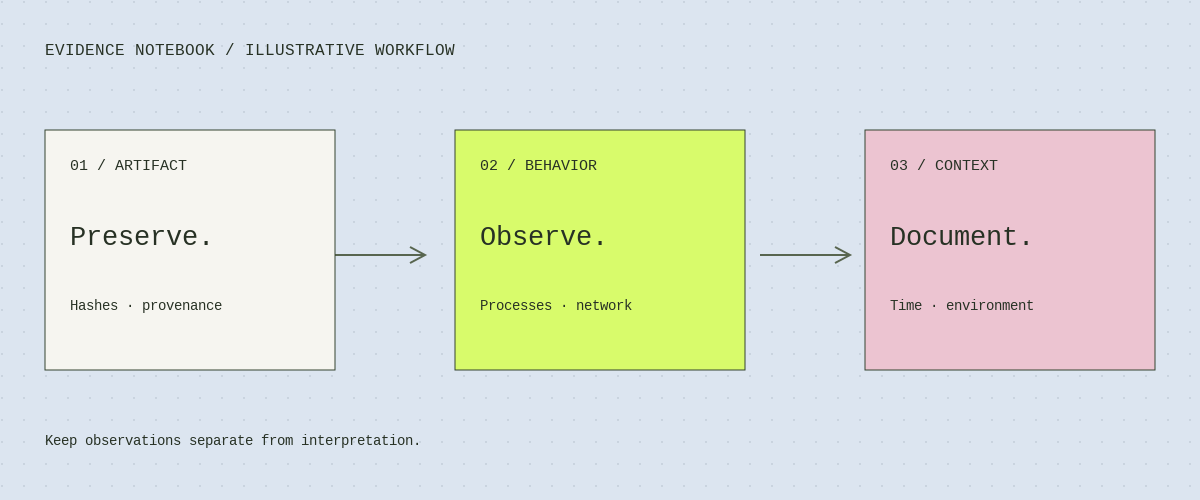
This is a conceptual workflow, not a report of a specific incident. The diagram below uses Mermaid to show how an observation becomes a documented finding, including the questions that send us back for another look.
flowchart TD
    accTitle: From observation to documented finding
    accDescr: Preserve a suspicious artifact, observe it in an isolated lab, and collect evidence. If context is insufficient, return to observation; otherwise document the finding and share defensive takeaways.
    A[Preserve the artifact] --> B[Observe in an isolated lab]
    B --> C[Collect behavioral evidence]
    C --> D{Enough context?}:::decision
    D -->|Investigate further| B
    D -->|Yes| E[Document the finding]:::finding
    E --> F[Share defensive takeaways]
Use View diagram source to inspect the Mermaid definition. The diagram follows the site’s light and dark themes.
Keep investigating
Explore procSniper, CupaX Sandbox, or the rest of my public repositories.
There is always another question behind the next observation.